
Kitchen With Luxurious Marble Tops
- Home
- Case Studies
- Kitchen With Luxurious Marble Tops
The Setting
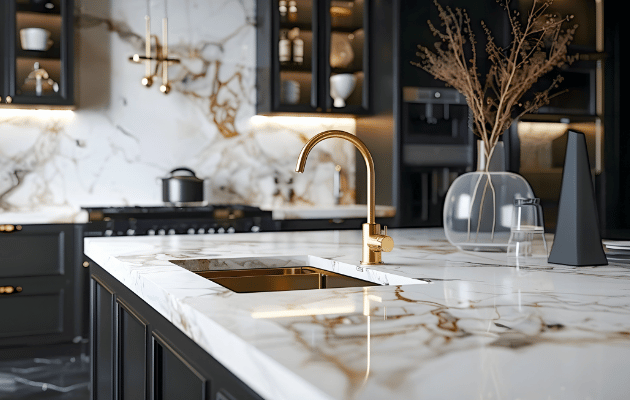
In many high-end homes across NY, NJ, and CT, the kitchen has become more than a place to cook—it’s a central gathering space. Large marble islands anchor the room. Countertops flow seamlessly into backsplashes. Waterfall edges, honed finishes, and subtle veining are chosen as much for their visual impact as for their timeless feel.
In settings like this, marble is used constantly. Morning coffee rituals, family meals, homework sessions, and evening entertaining all happen on the same surfaces. The stone is expected to look elegant while standing up to real life.
That combination—beauty and daily use—is exactly what makes marble so appealing, and also what creates long-term challenges.
The Risk or Challenge
Kitchens are one of the most demanding environments for natural stone. Even when homeowners are careful, marble surfaces are exposed to:
- Acidic foods and drinks like lemon juice, wine, tomatoes, and vinegar
- Frequent wiping and spot-cleaning throughout the day
- Cooking oils, spices, and food dyes
- Well-intentioned but inappropriate cleaners
In a luxurious kitchen, these interactions don’t usually cause dramatic damage overnight. Instead, they leave subtle marks: faint dull spots, light etches that catch the light at certain angles, or areas that no longer reflect evenly. Over time, these small changes accumulate, making the surface look worn despite being structurally sound.
Why This Surface Is Vulnerable
Marble is a calcium-based stone. That composition gives it depth, softness, and natural movement—but it also means marble reacts chemically with acids. Etching isn’t a stain sitting on the surface; it’s a microscopic change to the stone itself.
Honed and matte finishes, which are especially popular in luxury kitchens, can make etching less immediately visible—but not less likely. In fact, because these finishes rely on uniform texture rather than shine, even small disruptions can affect the overall appearance.
Add in frequent use and routine cleaning, and the stone experiences gentle but constant abrasion. Over time, this combination can lead to uneven wear that homeowners often mistake for “aging badly,” when in reality, the stone is behaving exactly as expected.
Where Protection Makes a Difference
A common misconception is that sealing alone prevents these issues. Traditional sealers help slow down staining by reducing absorption, but they don’t stop etching. Acid still reacts with marble regardless of whether the stone is sealed.
This is where etch-resistant protection enters the conversation—not as a repair, but as a planning decision. When protection is applied thoughtfully and with proper preparation, it creates a barrier that changes how the surface responds to daily use. Acidic spills are far less likely to leave visible marks, and routine cleaning becomes less risky.
In kitchens like this, protection doesn’t alter the look or feel of the marble. The goal isn’t to make the stone indestructible or artificial—it’s to preserve its appearance under real-world conditions.
Importantly, protection works best when the stone is in good condition to begin with. Addressing minor surface inconsistencies first ensures the finished result looks intentional and cohesive.
Key Takeaway
What homeowners often overlook isn’t the beauty of marble—it’s the difference between managing damage and preventing it. In a luxury kitchen, marble doesn’t fail because it’s fragile. It shows wear because it’s doing exactly what natural stone does when used daily.
Understanding that distinction changes the approach entirely. Instead of chasing small issues as they appear, proactive protection allows homeowners to enjoy their kitchen without constant worry about every spill or splash.
Marble can remain both elegant and practical—but only when its natural characteristics are respected and planned for.
Considering Your Own Stone Surfaces?
Every kitchen and stone surface is used differently. If you’re wondering how marble behaves in real-world kitchen environments—or whether etch-resistant protection makes sense for your countertops, backsplashes, or islands—learning what to expect ahead of time can make all the difference.
Thoughtful guidance can help you care for your stone with confidence, not caution.
You can explore your options or ask questions through our Contact Us page, or speak with our team directly at (516) 760-3538.