
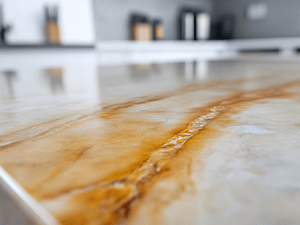
Noticing etch marks on a marble countertop can be unsettling—especially when the stone is otherwise beautiful and well cared for.
A dull spot near the sink, a cloudy ring where a glass once sat, or light marks around a prep area often raise the same question:
Did something go wrong?
Etching is one of the most common issues marble owners encounter, and it’s also one of the most misunderstood. The good news is that etching doesn’t mean your countertop is ruined. In fact, there are several practical options—each suited to different goals, lifestyles, and expectations.
First, What Etching Really Means
Etching is not a stain.
Marble is a calcium-based stone, and when it comes into contact with acidic substances—such as citrus juice, wine, vinegar, or certain cleaners—a chemical reaction occurs at the surface. That reaction slightly alters the texture of the stone, leaving behind a dull or lightened area.
Because etching affects the surface itself, it won’t wipe away with cleaning. It also isn’t caused by neglect or poor-quality stone. It’s simply how marble behaves.
Option 1: Leave It As-Is
For some homeowners, the simplest option is to do nothing.
Light etching doesn’t affect the strength or function of the countertop. In many homes, especially those with honed marble, etches blend into the surface over time and become part of the stone’s natural patina.
This approach works best if:
- The etching is minimal
- Appearance isn’t a major concern
- You’re comfortable with marble showing signs of use
Many long-standing marble installations develop this lived-in look naturally.
Option 2: Adjust Daily Care Habits
If etching is limited but recurring, small changes in daily habits can help slow it down.
Helpful adjustments include:
- Using pH-neutral cleaners only
- Wiping acidic spills within a reasonable time
- Avoiding vinegar-based or abrasive products
- Using cutting boards, trays, or mats in prep areas
These steps won’t eliminate etching entirely, but they can reduce how quickly it appears—especially on polished surfaces.
Option 3: Professional Surface Refinishing
When etching becomes visually distracting, professional refinishing is often the most effective solution.
Refinishing involves carefully restoring the surface to remove etch marks and re-establish the original finish—polished or honed. Because etches affect the surface texture, they can often be corrected without replacing the stone.
This option is ideal when:
- Etching is widespread or uneven
- The countertop looks dull or patchy
- You want to restore a clean, uniform appearance
After refinishing, the surface essentially gets a fresh start.
Option 4: Improve Etch Resistance Going Forward
Correcting etches addresses what’s already happened. Improving etch resistance helps manage what happens next.
Marble can’t be made completely etch proof, but it can be made more etch resistant, meaning everyday contact is less likely to leave immediate, visible marks. This makes marble countertops more forgiving in kitchens where acids are part of normal use.
This option is often considered after refinishing, when the surface is in its best condition.
Option 5: Rethink Finish Expectations
Finish plays a significant role in how etching appears.
- Polished marble shows etches more clearly because they interrupt the reflective surface.
- Honed marble still etches, but the marks are far less noticeable.
Some homeowners choose to transition from a polished finish to a honed one during refinishing. This doesn’t prevent etching, but it can make future wear feel less disruptive.
It’s a practical choice for kitchens that see frequent use.
Option 6: Understand What Sealing Can—and Can’t—Do
Sealing is often part of marble care, but it’s important to understand its limits.
Sealants help slow absorption and reduce staining. They do not prevent etching. Even a well-sealed countertop can etch quickly when exposed to acids.
If etching is the primary concern, sealing alone won’t solve the issue—but it can still play a supporting role alongside other strategies.
Choosing the Right Option Depends on You
There’s no single “correct” response to marble etching. The right option depends on:
- How noticeable the etching is
- How the countertop is used
- Whether appearance or practicality is the priority
- Long-term expectations for the space
In residential kitchens, comfort and ease of use often guide decisions. In higher-end or highly visible spaces, consistency and appearance may matter more.
The key is making an informed choice rather than reacting out of frustration.
Etching Is a Characteristic, Not a Failure
Marble countertops etch because they’re made of real stone—not because something went wrong. Understanding this reframes the issue from damage control to thoughtful care.
With the right approach, etched marble can be restored, managed, and lived with confidently. The goal isn’t to eliminate marble’s nature, but to work with it in a way that fits your space and your expectations.