
Marble Backsplash
- Home
- Case Studies
- Marble Backsplash
The Setting
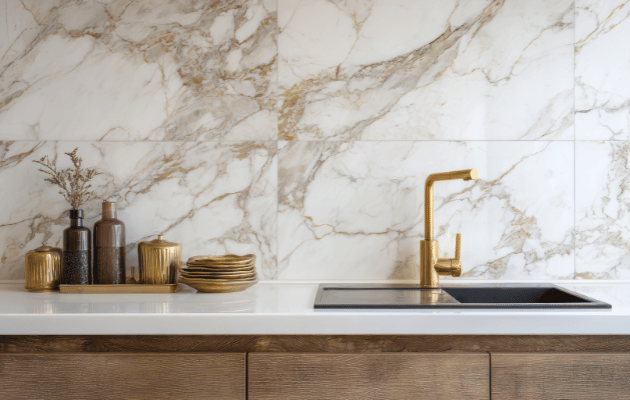
In many kitchens across NY, NJ, and CT, marble backsplashes are chosen to complement countertops and cabinetry while adding visual continuity to the space. Full-height slabs, bookmatched panels, and softly veined tiles are common in both classic and contemporary kitchens.
A marble backsplash often sits directly behind ranges, sinks, and prep areas. It’s exposed daily to splashes, steam, cooking oils, sauces, citrus, and frequent wipe-downs. While it may not bear weight like a countertop, it absorbs the visual impact of kitchen activity more than almost any other surface.
In settings like this, the backsplash becomes both a design feature and a working surface—whether intended or not.
The Risk or Challenge
Marble backsplashes tend to experience gradual, uneven change rather than obvious damage. Common issues include:
- Etching from acidic food splatter (tomato sauce, lemon, vinegar)
- Darkening near cooktops from oils and heat exposure
- Streaking or dull patches from repeated cleaning
- Discoloration caused by cleaners not formulated for natural stone
Because backsplashes are vertical, these changes are often noticed only when light hits the surface at an angle. What starts as a barely visible mark can slowly disrupt the uniform appearance of the stone, especially on polished finishes.
Homeowners are often surprised when a backsplash begins to look worn despite careful use—largely because it’s not seen as a “high-risk” surface.
Why This Surface Is Vulnerable
Marble is a calcium-based stone, which means it reacts chemically with acids. Etching doesn’t sit on the surface like a stain—it alters the stone itself at a microscopic level.
Backsplashes face a unique combination of stress:
- Repeated exposure to acidic splashes
- Heat and airborne grease near cooktops
- Frequent wiping in small, concentrated areas
Polished marble backsplashes, in particular, reveal etching more easily under task lighting. Even honed finishes, while more forgiving visually, can develop uneven texture over time.
Unlike countertops, backsplashes are often cleaned quickly and casually—sometimes with whatever product is nearby. This well-intentioned habit can accelerate surface wear without anyone realizing it.
Where Protection Makes a Difference
A common scenario involves relying solely on sealing to protect a marble backsplash. While sealers help slow absorption and reduce staining, they do not prevent etching. Acidic splashes will still react with the stone, sealed or not.
Etch-resistant protection changes how the surface responds to daily kitchen activity. When applied with proper preparation, it creates a barrier that helps shield marble from common backsplash-related exposures—without altering its appearance.
In backsplash applications, protection can:
- Reduce visible etching from food and cooking splatter
- Make routine cleaning safer and more forgiving
- Help maintain consistent appearance across large vertical areas
- Extend the time before refinishing becomes necessary
Rather than reacting to damage after it appears, protection supports long-term visual consistency—especially in kitchens where marble is used extensively.
Key Takeaway
Marble backsplashes don’t wear out because they’re fragile. They change because they’re placed directly in the path of daily kitchen use.
Understanding how marble behaves in this environment allows homeowners and designers to plan accordingly. With realistic expectations and preventive protection, a marble backsplash can remain a refined, cohesive part of the kitchen—not a surface that quietly deteriorates over time.
A Smarter Way to Care for Stone
Understanding your stone surfaces is the first step toward protecting them properly. If you’d like help evaluating your backsplash or learning more about preventive options for marble in kitchen environments, TriState Stone Protection is here as a resource.
You can reach us through our Contact Us page or speak with our team at (516) 760-3538.